One of the criticisms of the Bhutto-Sharif game of musical chairs was that the civilian-led governments of the 90s were undoubtedly corrupt. Musharraf's coup, the immediate reason for which was the general being fired by the then prime minister, Nawaz Sharif, was later justified on the grounds of corruption. Now 7 years into his rule, Musharraf stands accused of sitting atop a pyramid of corruption that, in the eyes of the public, exceeds that of the civilian governments of the 90s.
From the National Corruption Perception Survey 2006:
Comparative assessment about the previous of government of Ms.Benazir , Mr.Nawaz
Sharif, the first phase of each one has been rated as less corrupt than second phase. In
case of General Pervaiz Musharaf the 1st period (without assemblies) is cleaner than
the 2nd period (with assemblies), and the corruption has been linked with inflation,
unemployment, Power shortage, ris ing trend of street crimes.
Click here for the main page of Transparency Internatinal's Pakistan site.
Tuesday, September 19, 2006

Wednesday, September 06, 2006
Deal with Taliban panned
The reaction to the government's deal with the militants in Waziristan has been given the thumbs down by the Western media. Click here to read the CS Monitor's review of comment on the deal.
Tuesday, September 05, 2006
HRCP clarifies
The Sept. 1 countrywide strike to protest the killing of Nawab Akbar Bugti was supported by opposition parties, sundry organisations - and the Human Rights Commission of Pakistan.
The HRCP's endorsement of a strike was contrary to its purpose and seemingly undermined the tremendous work carried out over the years. I e-mailed Asma Jahangir, Chairperson of the HRCP, requesting her to explain the HRCP's position. Below are excerpts from the correspondence:
The HRCP's endorsement of a strike was contrary to its purpose and seemingly undermined the tremendous work carried out over the years. I e-mailed Asma Jahangir, Chairperson of the HRCP, requesting her to explain the HRCP's position. Below are excerpts from the correspondence:
| Cyril Almeida | | |
| To: AGHS | ||
| ||
| AGHS | | |
| To: Cyril Almeida | ||
| ||
Sunday, September 03, 2006
Soft image?
Pakistan's quest for a soft image just got brighter - Mariyah Moten was the Pakistani representative at a no-name bikini contest held in China.
Cue the beards to denounce women, freedom, sex, and all-around depravity of modernity.
Update (Sept. 6): Government reaction
“In Pakistani culture, there is a tradition of cattle shows only, whereas women are connected with respect and honour of the family,” an official told The News in a bid to distance itself from the bikini contest.
Cue the beards to denounce women, freedom, sex, and all-around depravity of modernity.
Update (Sept. 6): Government reaction
“In Pakistani culture, there is a tradition of cattle shows only, whereas women are connected with respect and honour of the family,” an official told The News in a bid to distance itself from the bikini contest.
Tuesday, August 29, 2006
Bugti and the Baluch insurgency
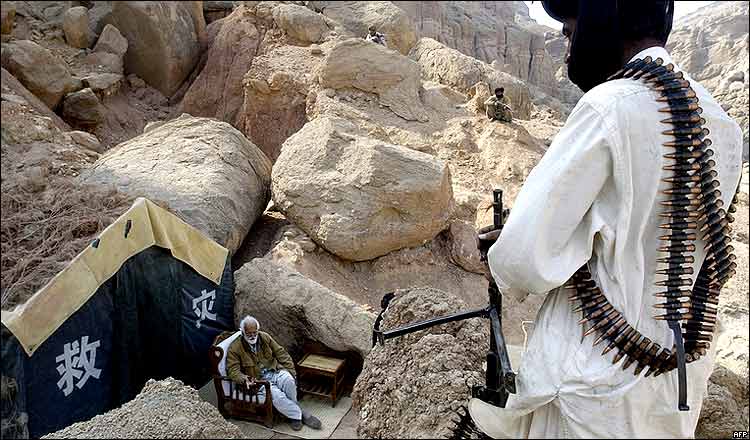
In the aftermath of the killing of Nawab Akbar Bugti one of the casualties has been informed commentary. Sifting through the slew of articles does, however, unearth the Nawab's background, his role in the present Baluch insurgency and the regional impact of the insurgency.
From Time magazine's Pakistan's Other War, a look at the complex, contradictory Nawab:
"Bugti symbolizes Baluchistan's character. He says he killed his first man when he was just 12, and his life ever since has been a series of unending blood feuds with other clans and with the Pakistani military. Bugti sees himself as a warrior fighting a noble cause. He is self-taught and an avid reader—until March, the library in his rambling, earthen castle was lined with hundreds of books on philosophy, Western and oriental religions and the European classics. Then the castle, and the library with it, were destroyed by army cannon fire. Bugti is a vegetarian, a rarity among the meat-chomping Baluch, and sups every night on a bowl of green chili peppers, according to a frequent guest."
On Bugti becoming the face of the current insurgency, Imtiaz Alam writes in The News:
"Ironically Akbar Bugti had never joined the nationalist movement or the alliances of various nationalist groups formed in Pakistan ... He became chief minister during the first tenure of former prime minister Nawaz Sharif and ran the province like an authoritarian patriarch. However, he developed serious differences with Islamabad over the issue of royalty which he said that the government needed to pay to him for the Sui gas field.
"His survival depended on making a larger nationalist cause out of this dispute, especially when he was engaged in a battle with the rival Kalpar Bugti clan and at a time when the military authorities were bent upon constructing a garrison in the area.
"The fact of the mater is that after losing his sons Akbar Bugti had taken refuge in his home town, Dera Bugti, to evade retaliation from the clans locked in a bloody feud with him on the one hand and to put up resistance to the Musharraf government and the military's plans to establish a cantonment in the area on the other. The construction of the cantonments became the main irritant to Bugti who wanted to keep his tribal-feudal fiefdom unchallenged."
On the possible transnational impact of Bugti's killing, The Christian Science Monitor reports:
"Bugti's death could also reverberate in the region, some analysts say. The Balochis are spread across several countries, with millions living in parts of Iran and Afghanistan that border Pakistan."
The CS Monitor's report also adds the following on the fight against the Taliban:
"The province also shares hundreds of miles of unmanned border with Afghanistan, giving the Taliban a sprawling front for their operations.
"The solution, such as it exists, masks a potent irony. The most effective counterbalance to the Taliban, observers say, are the very people the Army is targeting in its military operations.
"Baloch nationals have acted as a countervailing force to extremists, espousing democratic and liberal political values, observers say. In the arena of the provincial assembly, Baloch leaders argue, they regularly battle against measures that create an amenable atmosphere to the Taliban."
Lest one assume that the regional dimensions of the current insurrection are exaggerated, consider this report from GlobalSecurity.org on the last insurgency in the 1970s:
"External assistance to Bhutto was generously given by the shah of Iran, who feared a spread of the insurrection among the Iranian Baloch."
Saturday, August 26, 2006
Sex, lies, and beards
When is a rape not a rape? When it is committed by a husband, according to Aamir Liaquat Husain a.k.a. Dr. Fake, Minister of State for Religious Affairs in this government of enlightened moderation. Mr. Liaquat made his assertion in response to a demand that marital rape be recognised as a crime. The demand was made by Kashmala Tariq, member of the National Assembly Select Committee on Women’s Protection Bill, citing a woman's right not to be treated as a 'buffalo'.
ISI and Jenna Bond?
Camera rings. Fervent speculation. Massive manhunts. Rafata, a Kashmiri woman, has Indian Punjab in a tizzy: police are desperate to locate the alleged ISI spy who 'heads one of the biggest spy networks for Kashmiri militants'. ISI: An equal opportunity employer.
He said, she said
With the explosion in the number of op-ed contributors in the country's dailies, the quality of the commentary has often been criticised. In an op-ed column for The Nation, Wajahat Latif began by attacking Dushka Saiyid, wife of Mushahid Hussain and a current Allama Iqbal Fellow at Cambridge, for allegedly ignoring the military's role in the country's brief experiments with democracy.
I e-mailed Dr. Saiyid and requested a response to Mr. Latif's claim. The following are excerpts from the e-mail exchange:
I e-mailed Dr. Saiyid and requested a response to Mr. Latif's claim. The following are excerpts from the e-mail exchange:
| Cyril Almeida | | |
| To: Dushka Saiyid | ||
| ||
| dushka saiyid | | |
| To: Cyril Almeida | ||
| ||
Friday, August 25, 2006
Mo' money, no problems
500 million. That's what it costs to ferry Musharraf and his sidekick, Shaukat Aziz, to and fro on their mission to drag Pakistan into the 20th century - yet, it's already the 21st century, but they would do well to keep us only a few decades behind modernity.
From the government's website comes this list of journalists allotted plots in Islamabad. Dawn, The News, Daily Times, The Nation and Business Recorder all have successful candidates.
From the government's website comes this list of journalists allotted plots in Islamabad. Dawn, The News, Daily Times, The Nation and Business Recorder all have successful candidates.
Tuesday, August 22, 2006
A new father of the nation?
If the beards had their way, Jinnah would likely be erased from Pakistan's history. But since their time has not yet come to pass, they have to make do with excising the memory of Jinnah from their personal lives. So it is that Fazlur Rehman, leader of the opposition in the National Assembly, has taken down the portrait of Jinnah in his parliamentary chambers - and replaced it with one of his father, Mufti Mehmood.
What values did the late Mufti Mehmood espouse that make him a better role model than Jinnah?
According to Aijazz Ahmed: 'Both Mufti Mehmood and Maulana Maodudi played vital and central roles in the politics of Pakistan after partition and they provided their weight to general Zia ul-Haq's toppling of a democratically-elected government for a military coup in 1977.'
The arch constitutionalist discarded in favour of a father who supported the country's most regressive military dictator - sometimes a son's love is a nation's fear.
What values did the late Mufti Mehmood espouse that make him a better role model than Jinnah?
According to Aijazz Ahmed: 'Both Mufti Mehmood and Maulana Maodudi played vital and central roles in the politics of Pakistan after partition and they provided their weight to general Zia ul-Haq's toppling of a democratically-elected government for a military coup in 1977.'
The arch constitutionalist discarded in favour of a father who supported the country's most regressive military dictator - sometimes a son's love is a nation's fear.
Sunday, August 20, 2006
An unhappy marriage, but no divorce
The alleged London airline terror plot has prompted a slew of commentary in the American and British press on Pakistan's role in global terrorism.
The key concerns are summed up by an Aug. 14 article in the New York Times:
'A series of planned terrorist attacks with links to Pakistan as well as a sharp rise in crossborder Taliban attacks in Afghanistan have prompted renewed debate within the Defense Department about Pakistan, according to two people involved who requested anonymity because they were not authorized to comment publicly.
They said that in particular, the sharply rising American casualty rate in Afghanistan had increased skepticism among some American military officers about the Pakistani intelligence service’s efforts to rein in the Taliban.
“There is an increasing view in the United States that Pakistan isn’t very helpful,” said one researcher involved in the debate, referring to frustration among some officers. “There are people who are really thinking twice about this relationship with Pakistan.”'
Lest one be tempted to think that support for Gen. Musharraf is ebbing, an op-ed column co-authored by Richard Armitage in today's New York Times dismisses that notion:
'We believe General Musharraf continues to stand for these principles (enlightened moderation) and deserves our attention and support, no matter how frustrated we become at the pace of political change and the failure to eliminate Taliban fighters on the Afghan border.'
So despite being caught in, according to Sengupta in her Aug. 14 article, 'one of the most serious political binds of his nearly seven-year tenure', Gen. Musharraf still has the support of his chief patrons. For Pakistanis, the 'war on terror' can more aptly be described as the war on democracy.
Saturday, August 19, 2006
Musharraf the real target of London airline plot?
According to John B. Roberts II, an official in the Reagan White House, the alleged terrorist plot uncovered by British and Pakistani intelligence agencies was aimed squarely at Musharraf:
' The objective of those who backed the British plotters was to pull off a terrorist spectacular that would demonstrate the strength of the Islamic militancy and spark popular uprisings against the Musharraf government. The symbolism of Pakistan breaking away from its close alliance with the West on its 59th celebration of independence would have resonated throughout the Muslim street. Pakistani officials are probing whether there was an inside coup plan to complement the terrorist plot and planned street agitation.'
Hyperbole? Probably. But if true, it may be the best news Musharraf has heard in a while. Lashed by domestic crises and faced with political opposition that is increasingly united, another assassination attempt would ensure virtual carte blanche in domestic politics for the general from his American supporters.
' The objective of those who backed the British plotters was to pull off a terrorist spectacular that would demonstrate the strength of the Islamic militancy and spark popular uprisings against the Musharraf government. The symbolism of Pakistan breaking away from its close alliance with the West on its 59th celebration of independence would have resonated throughout the Muslim street. Pakistani officials are probing whether there was an inside coup plan to complement the terrorist plot and planned street agitation.'
Hyperbole? Probably. But if true, it may be the best news Musharraf has heard in a while. Lashed by domestic crises and faced with political opposition that is increasingly united, another assassination attempt would ensure virtual carte blanche in domestic politics for the general from his American supporters.
Friday, August 18, 2006
Vermont to Pakistan
Pakistan just can't cut a break. When a white American woman, Catharine Mayo, became unruly on a London-to-Washington D.C., leading to a security scare and an emergency landing in Boston, a Pakistani connection seemed improbable.
But when the Associated Press sent a reporter to Mayo's hometown of Braintree (population: 1,200) in Vermont, the improbable became fact: Ms. Mayo has been a frequent visitor to Pakistan since 9/11. But unlike most of the visitors to Pakistan in the news lately, Ms. Mayo was neither a guest of one of the country's estimated 14,000 madressas nor did she meet any terrorist mastermind; instead she came to Pakistan to visit her boyfriend who was unable to secure a US visa.
Described by her son as a peace activist, Ms. Mayo published her views on American democracy in the Daily Times in 2003.
But when the Associated Press sent a reporter to Mayo's hometown of Braintree (population: 1,200) in Vermont, the improbable became fact: Ms. Mayo has been a frequent visitor to Pakistan since 9/11. But unlike most of the visitors to Pakistan in the news lately, Ms. Mayo was neither a guest of one of the country's estimated 14,000 madressas nor did she meet any terrorist mastermind; instead she came to Pakistan to visit her boyfriend who was unable to secure a US visa.
Described by her son as a peace activist, Ms. Mayo published her views on American democracy in the Daily Times in 2003.
Sunday, August 13, 2006
Absentee democracy
As the country's political elite gear up for next year's general election, 'democracy' is this political season's hottest accessory - everyone wants a piece of it. The government led by a serving uniformed general claims it has already given the people democracy; nonsense, cry the opposition, pointing out that parliament is parody of itself.
Who is right? Absentee ministers and a helpless speaker tell their own tale; the claims of democracy ring hollow when the government's ministers bluntly remind the country that power lies not with the people, but with Musharraf. 7 years into his rule, on the eve of Pakistan's independence, the General has not led us out of the wilderness. Indeed, he seems eager to continue for another 33. But on the evidence before us thus far, even a miracle of Biblical proportions may not be able to deliver democracy then.
Who is right? Absentee ministers and a helpless speaker tell their own tale; the claims of democracy ring hollow when the government's ministers bluntly remind the country that power lies not with the people, but with Musharraf. 7 years into his rule, on the eve of Pakistan's independence, the General has not led us out of the wilderness. Indeed, he seems eager to continue for another 33. But on the evidence before us thus far, even a miracle of Biblical proportions may not be able to deliver democracy then.
Monday, July 24, 2006
Bureaucrats' SOS
The Pakistani bureaucracy is often accused of being corrupt, incompetent and in disarray. Poor training, spotty accountability and great power are a poisonous combination in any organisation. Add political interference to that combination and the possibility of a turnaround is further diminished.
In an era when good governance is one of the government's favourite catchphrases, the bureaucrats' political masters are increasingly being blamed for exacerbating the sorry state of affairs. For every Saira Kazim, Dr. Aleem Mehmood and Javed Nizam that the public hears of, there are likely scores of other civil servants who acquiesce to illegal demands.
In an era when good governance is one of the government's favourite catchphrases, the bureaucrats' political masters are increasingly being blamed for exacerbating the sorry state of affairs. For every Saira Kazim, Dr. Aleem Mehmood and Javed Nizam that the public hears of, there are likely scores of other civil servants who acquiesce to illegal demands.
Tuesday, July 18, 2006
The general's shame
Enlightened moderation be damned when there's power to be held on to. Musharraf has spoken: the misogynistic Hudood Ordinance is only to be amended, not repealed.
Ignoring the impassioned case presented by three sensible ministers to scrap the ordinance altogether, Musharraf saw sense in the following:
The president was told that according to one proposed amendment, if charges of adultery were not proved against an accused woman, the person levelling the allegation would be prosecuted.
The flip side is that where adultery can be 'proved' women ought to be thrown into jail. The beard's must secretly be rejoicing: if this is the furthest a liberal dictator can go, surely the beards' time will come.
For women this is yet another case of one step forward, two steps backward. A cuckolded husband's motive for prosecution is almost invariably vengeance, which, even in the absence of conclusive proof, may still be fulfilled by a conservative judiciary and a shambolic judicial process. Indeed, the trial process itself is akin to punishment in Pakistan.
Even the eternal optimists must surely have lost faith in Musharraf by now. 7 years into his rule, he can't still claim to be biding his time.
Monday, July 17, 2006
Could Maduro and Oscuro be far off?
The establishment of a Cuban embassy in Islamabad is testament to the possibilities of solidarity in the midst of adversity: Cuba sent 2,400 doctors and medical staff to Pakistan's quake ravaged northern areas last year despite not having diplomatic relations with the country at the time. It is only right that Pakistan at least have taken this small step to express its gratitude.
Amazingly, the Cubans are not satisfied with just providing us with fish - they want to teach us how to fish, too. The Cuban healthcare system is one that Pakistan, indeed most developing countries, would do well to emulate. The system does have its critics, but they emphasise the problems of resource allocation in a centralised economy - something Pakistan does not have to fear in the foreseeable future.
The 1,000 medical scholarships the Cubans are offering will be a boost to Pakistan's chronically understaffed clinics and hospitals. However, the full effect of the Cuban miracle will only be felt if Pakistan's policy makers and administrators are also sent across to learn how the system itself operates: governance and development issues are fundamentally about good management.
The choice is ours: will we import knowledge or will we import cigars?
Amazingly, the Cubans are not satisfied with just providing us with fish - they want to teach us how to fish, too. The Cuban healthcare system is one that Pakistan, indeed most developing countries, would do well to emulate. The system does have its critics, but they emphasise the problems of resource allocation in a centralised economy - something Pakistan does not have to fear in the foreseeable future.
The 1,000 medical scholarships the Cubans are offering will be a boost to Pakistan's chronically understaffed clinics and hospitals. However, the full effect of the Cuban miracle will only be felt if Pakistan's policy makers and administrators are also sent across to learn how the system itself operates: governance and development issues are fundamentally about good management.
The choice is ours: will we import knowledge or will we import cigars?
Thursday, July 13, 2006
The secret war
In an interview with a local news channel, Musharraf has rejected Nawaz Sharif's claim that he was in the dark over the Kargil conflict until Atal Behari Vajpayee, then Prime Minister of India, called to demand an explanation.
Let's set aside the accusations and counter-accusations for a minute - from the assassination of the first Prime Minister, Liaquat Ali Khan, onwards, Pakistanis have rarely learnt the truth on any matter of national interest - and instead focus on some of Musharraf's comments:
Sounding a note of warning, he said issues relating to Kargil were extremely confidential and of paramount national importance, and these should not be publicised in the way in which the former prime minister was doing so consistently.
“I would advise him to talk economically on this issue because it is an issue of great national confidentiality,” he said.
The reasons for provoking a war are of 'great national confidentiality'? If so, maybe even Allah won't be able to save us from ourselves.
Let's set aside the accusations and counter-accusations for a minute - from the assassination of the first Prime Minister, Liaquat Ali Khan, onwards, Pakistanis have rarely learnt the truth on any matter of national interest - and instead focus on some of Musharraf's comments:
Sounding a note of warning, he said issues relating to Kargil were extremely confidential and of paramount national importance, and these should not be publicised in the way in which the former prime minister was doing so consistently.
“I would advise him to talk economically on this issue because it is an issue of great national confidentiality,” he said.
The reasons for provoking a war are of 'great national confidentiality'? If so, maybe even Allah won't be able to save us from ourselves.
From Muridke to Bombay: Lashkar-e-Taiba's journey of mayhem?
The future is now. Yesterday I posted an article from the Economist, The future looks bearded, which criticised Musharraf's chicanery when it has come to dealing with Islamic extremists, particularly Jamaat-ul-Dawa, the alter ego of Lashkar-e-Taiba.
Then the dastardly attack on Bombay's trains shook the world. Lashkar-e-Taiba have denied involvement, but the use of RDX explosives and other intelligence indicate elsewise. It is too early to reach any conclusions on the Bombay attack. But it is not too early for Pakistan to dismantle Laskhar-e-Taiba and its counterparts. Indeed, it may already be too late.
Then the dastardly attack on Bombay's trains shook the world. Lashkar-e-Taiba have denied involvement, but the use of RDX explosives and other intelligence indicate elsewise. It is too early to reach any conclusions on the Bombay attack. But it is not too early for Pakistan to dismantle Laskhar-e-Taiba and its counterparts. Indeed, it may already be too late.
Wednesday, July 12, 2006
The Economist on Pakistan, Part IV
The future looks bearded is perhaps the best article in the Economist's survey of Pakistan because it nails a key problem of Musharraf - his half-hearted attempts to tackle extremism. As this editorial in the News points out Musharraf is adept at making the right noises, but poor when it comes to delivering.
The Musharraf era is rife with contradictions when it comes to dealing with Islamist extremists: ban the Lashkar-e-Taiba, but let its alter ego, Jamaat-ul-Dawa, flourish; hound the secular PPP, but cut a deal with bearded politicos; jail reporters rather that the Taliban they report on.
Pakistan's political elite have a painful habit of dismissing the past. 1971, a monstrous war that ought to have been seared on our collective conscience, elicits no more than a shrug. The senseless Kargil war has been forgotten even during the rule of its architect, Musharraf. The Afghan war only stayed on the radar because of the devastation it wrought on Pakistani society in the form of guns, drugs, and Islamic extremism.
9/11 was a major blow to the Americans, but it was also a stark warning to Pakistan: slay the dragon of Islamist extremism or else it will destroy you. Musharraf decided to play with fire instead. As a result, 5 years on, Pakistan is a more dangerous place.
The Musharraf era is rife with contradictions when it comes to dealing with Islamist extremists: ban the Lashkar-e-Taiba, but let its alter ego, Jamaat-ul-Dawa, flourish; hound the secular PPP, but cut a deal with bearded politicos; jail reporters rather that the Taliban they report on.
Pakistan's political elite have a painful habit of dismissing the past. 1971, a monstrous war that ought to have been seared on our collective conscience, elicits no more than a shrug. The senseless Kargil war has been forgotten even during the rule of its architect, Musharraf. The Afghan war only stayed on the radar because of the devastation it wrought on Pakistani society in the form of guns, drugs, and Islamic extremism.
9/11 was a major blow to the Americans, but it was also a stark warning to Pakistan: slay the dragon of Islamist extremism or else it will destroy you. Musharraf decided to play with fire instead. As a result, 5 years on, Pakistan is a more dangerous place.
The future looks bearded
Jul 6th 2006
From The Economist print edition
From The Economist print edition
Islamist militancy is alive and well
ON OCTOBER 8th 2005, earthquakes rippled across northern Pakistan and the area of Kashmir it controls, opening mile-wide fissures and sending mountain villages clattering into the valleys below. Over 70,000 people died in the debris and 3m more were made homeless. The army took days to deliver much relief, and the civil administration proved ineffective. But from one direction help came fast: hundreds of bearded Islamists, including armed guerrillas already in the area to infiltrate the nearby border with India, pitched tents and began dispensing aid.
| |
 | |
The cartoon that turned serious |
They are doing so still, long after most foreign agencies came and went, and Kashmiris are indebted to them. The interior minister, Mr Sherpao, has called them “the lifeline of our rescue and relief work”. The biggest Islamist charity, Jamaat-ul-Dawa (JUD), has supplied the army with medicines. After the quakes, JUD's fundamentalist helpers ferried NATO soldiers across angry rivers. Yet in April America banned the charity, which is a front for the biggest Islamist militant group in Indian-held Kashmir, Lashkar-i-Toiba. Founded by JUD's leader, Hafeez Saeed, it is banned by Pakistan, America and the UN because of its close links to al-Qaeda, and because it tried to kill General Musharraf. But Pakistan refuses to ban JUD.
There are dozens of militant groups in Pakistan, including several, like JUD, that are banned under other names. Most, including JUD/Lashkar, have roots in the Afghan jihad of the 1980s, when General Zia's intelligence agents armed them to fight the Soviet Union with American and Saudi cash. After the Soviet army withdrew in 1989, Pakistan sent the jihadists to Indian-held Kashmir to help wage an insurgency estimated (by India) to have claimed over 40,000 lives.
Pakistani governments also used them to fight their wars at home. They armed Sunni militants to kill Iranian-backed Shia groups, for example, and turned a blind eye when these assassins also killed Christians, Hindus and members of other Muslim sects. Some 4,000 Pakistanis, mostly Shias, are estimated to have died in sectarian violence in the past 15 years, especially in poor, swollen Karachi.
From the start, General Musharraf seemed to realise that this was a mess. He denounced extremism shortly after his coup and has campaigned against it since, but selectively. He has caught scores of al-Qaeda members and handed them to America, including Khaled Sheikh Mohammed, designer of the attacks on New York's twin towers. He has turned his back on the Taliban government in Afghanistan, but arrested few of its members when they fled to Pakistan. He has sent Pakistani troops into the northern tribal areas to fight the foreign jihadists who have found refuge there (see article). He has stopped, or at least greatly reduced, support for the militant groups in Kashmir. But he has not dismantled the biggest group, JUD/Lashkar, or arrested its leaders; and sectarian murders continue. Justice rarely catches up with the killers. Though a few dozen are currently on death row, the supreme court's judges are too frightened of a deadly reprisal to hear their appeals.
There are two explanations for General Musharraf's reluctance to crack down harder, and probably both are correct. The first is that, unlike America, he distinguishes between truly dangerous militants, such as members of al-Qaeda, and those that he thinks he can control.
The second explanation for General Musharraf's half-measures is that he is afraid of the extremist groups. There may be only a few thousand active militants, but their potential support is much greater. The biggest jihadi newspapers, including several banned under different names, have print-runs of up to 100,000. Islamic extremists are the only political force in Pakistan easily able to rally a crowd. On February 14th, after JUD's Mr Saeed denounced cartoons of the Prophet published in a Danish newspaper, a mob rampaged through Lahore, burning hundreds of cars and foreign businesses as well as the Punjab provincial assembly. JUD thugs were in the thick of it. “They have to be squeezed systematically,” said a senior intelligence official. If confronted suddenly, “they will kill the president, the prime minister, a couple of generals, a couple of chief ministers; there will be bomb blasts all over India.”
The militants would pose a security threat to Pakistan and its region even if deprived of the state support that they have enjoyed for so long. There is no question, however, of them taking over the country soon. A heavy majority of Pakistanis, certainly outside North-West Frontier Province, are politically secular. The Islamic parties have never won more than 11% of the vote—and that was with considerable help from General Musharraf.
But Pakistan is a bigoted place, and becoming more so. That may be true of all countries with a Muslim majority, yet few have hurtled towards the Islamist edge as fast as Pakistan. Its leaders are at least partly to blame. Almost all of them, civilian and military, have pandered to the mullahs. In 1977 whisky-swigging Zulfikar Ali Bhutto banned alcohol. Under General Zia, the only sincerely pious leader, Pakistan introduced draconian sharia punishments, made blasphemy a capital offence and ruled that unless rape victims could produce at least four male Muslim eye-witnesses they would be held guilty of fornication, a serious crime. Ms Bhutto did not seriously attempt to repeal these laws. Nawaz Sharif tried to introduce full sharia law. And General Musharraf helped the mullahs to unprecedented power. The Islamic parties, it should be noted, are not much better than any other extremist group in Pakistan: their ends are the same, and so, often, are their people.
Islamists have an influence in Pakistan far greater than their vote-count suggests. Take education. At the time of its creation, Pakistan had a couple of hundred Islamic schools, or madrassas. Now, having failed to build a decent education system, it has accumulated between 10,000 and 40,000 madrassas—up to 20% of which, according to a World Bank study, teach fighting skills. The national curriculum for regular schools is infected with religious and sectarian bigotry; until recently, ten-year-olds had to learn to “make speeches on jihad and shahadat (martyrdom)”.
Pakistan's impoverished public universities are largely controlled by the youth wing of the biggest Islamic party, Jamaat-e-Islaami. At the University of Punjab, in Lahore, these ambitious religionists have banned Coca-Cola, which they call “Jews' drink”. Last year, they broke the legs of a student accused of flirting with one of his female class-mates. In Islamabad, Quaid-i-Azam University has three mosques but no bookshop. One of Pakistan's handful of serious academics spoke yearningly of the liberal scholarly atmosphere he had recently enjoyed at a conference in Tehran.
Without deep reform to Pakistan's laws and institutions, a young and rapidly growing population seems likely to continue drifting towards extremism. An increase in public disorder and in electoral support for the mullahs would logically follow. Evidence from other countries suggests that economic growth would not prevent this. Nor will elections alone: indeed, Pakistan would perhaps be more Islamist but for the pervasive influence of its most undemocratic force, the feudal landlords, who keep rural mullahs in check.
After nearly seven years in charge, General Musharraf has overseen a few minor changes to the inflammatory school textbooks and promised a more thorough revision. “There will be no hate or teaching against any caste, sect, nationality or whatever,” says the education minister, Javed Ashraf Qazi. But given the president's lack of progress on repealing General Zia's Islamic laws, there is cause for some scepticism. True, the law ministry recently proposed changing the burden of evidence in rape cases, but its suggestion was not a liberal triumph: still four eye-witnesses, but only three of them need be Muslim males. As for madrassas, General Musharraf has introduced laws to bring them under closer supervision, but extremist institutions have ignored them.
The president also vowed to expel a couple of thousand foreign Islamic students, but he has not done so. The Jamia Binoria, a madrassa in Karachi, run by Deobandis, the sub-continent's home-grown extremists, has 4,500 students, including 500 foreigners. Sitting under whirling fans, during a break from the Koran, youths from countries including Britain, America, Canada and Australia said they had received notice last January to quit Pakistan, but the police had told them to ignore this.
Some liberal progress may yet emerge from General Musharraf's rule. If he fulfils his promise to improve regular schools, he may put many of the madrassas out of business. He has also liberated the media, prompting a proliferation of television stations that are giving Pakistanis more and better information about the outside world. Mullahs feature in many televised debates, and some of them sound quite sensible. One such pundit, Javed Ahmed Ghamidi, is no liberal: he supports the use of Islamic punishments, including amputations in extreme cases. He is scathing about America's recent foreign policy, but also about his own country's Islamic laws and Islamic parties. Having received death threats from JUD's Mr Saeed, he has only recently emerged from hiding. But unlike General Musharraf, Mr Ghamidi is a passionate democrat. “Pakistan should be a democratic state, neither secular nor Islamic,” he says.
Across Pakistan, roads are being excavated and optical-fibre cables laid. Television viewers can increasingly receive foreign stations, including Indian ones. Pakistani television stations are already putting out lots of Indian music videos, and in May for the first time broadcast a couple of carefully selected (and not terribly good) Indian films. Pakistan's beleaguered liberals are hoping for a cultural return from the Middle East, where General Zia dragged them. According to Khaled Ahmed, a Pakistani columnist: “If we lost our culture through Talibanisation in the west [of the country], we can get it back from India, where our culture is still alive.”
Subscribe to:
Posts (Atom)